Four Flow Strategies: From Balanced to Rapids
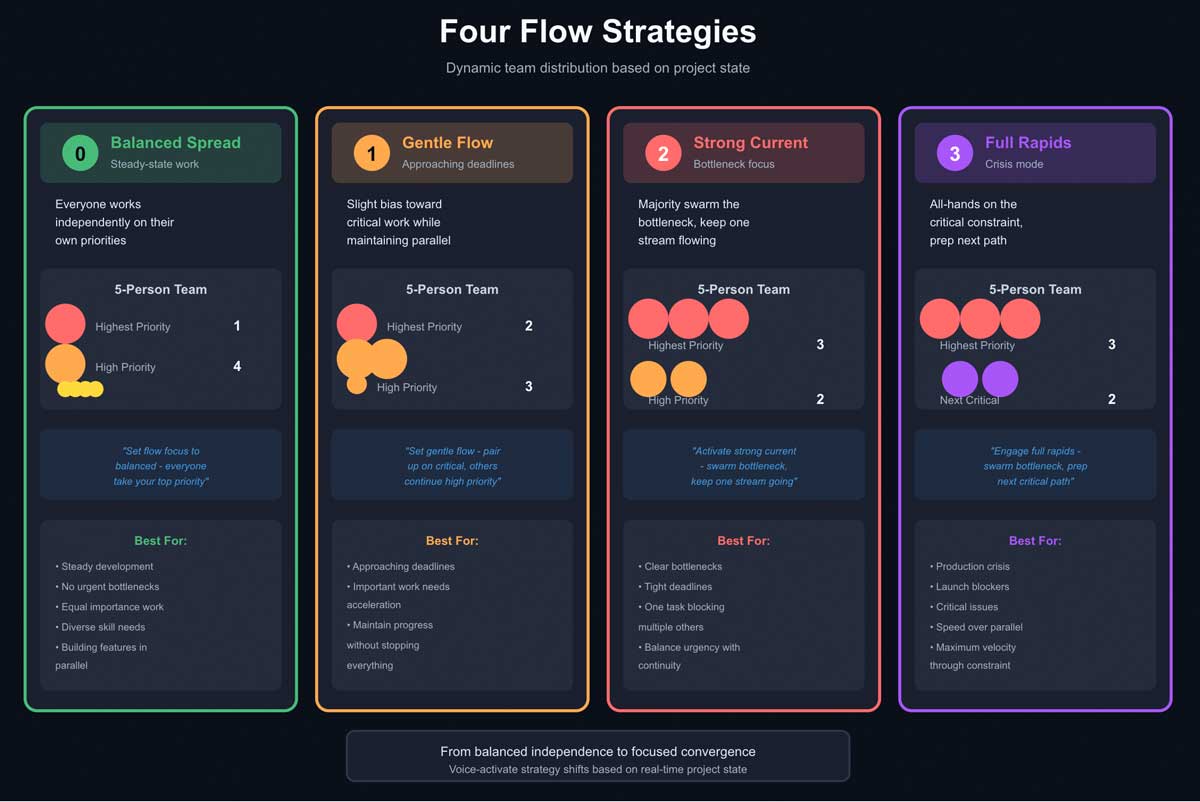
Four strategies for dynamic team distribution
November 5: The realization hit during a late-night coding session. Static task assignment doesn't match real project dynamics. Teams don't work the same way in steady-state development as they do approaching deadlines. They definitely don't work the same way during a production crisis. What if the AI could shift strategy based on project state? Not just "who should do this task," but "how should the entire team be distributed right now?"
The Problem with Static Assignment
Most project management tools, including our Phase 1 prototype, treat task assignment as a one-time decision. Assign Dana to debugging. Assign Chris to deployment. Done.
But real teams don't work that way. Project states change. Same team. Different contexts. Should the AI assign tasks the same way in all four scenarios? Probably not.
Strategy 0: Balanced Spread
Balanced Spread
Level 0Everyone works independently on their own priorities. Good for steady-state work when no urgent bottlenecks exist.
5-Person Distribution:
"Set flow focus to balanced - everyone take your top priority task"
Best for: Steady development phases, when all work is roughly equal importance, diverse skill requirements
Strategy 1: Gentle Flow
Gentle Flow
Level 1Slight bias toward critical work while maintaining parallel progress. Creates gentle pressure without overwhelming.
5-Person Distribution:
"Set gentle flow - pair up on the critical task, others continue high priority work"
Best for: Approaching deadlines, important but not crisis situations, when you want faster progress without stopping everything
Strategy 2: Strong Current
Strong Current
Level 2Majority focus on the bottleneck while keeping one stream of parallel work flowing. Balances urgency with continuity.
5-Person Distribution:
"Activate strong current - majority swarm the bottleneck, keep one high-priority stream flowing"
Best for: Clear bottlenecks identified, tight deadlines, when one task blocks multiple others
Strategy 3: Full Rapids
Full Rapids
Level 3All-hands convergence on the critical constraint. Maximum flow velocity through the bottleneck with prepared next steps.
5-Person Distribution:
"Engage full rapids mode - swarm the bottleneck, prep the next critical path"
Best for: Crisis mode, production issues, launch blockers, when speed matters more than parallel progress
Why This Matters
Most AI task assignment focuses on individual optimization: "Who is the best person for this task?" That's important, but it misses the bigger picture.
Flow strategies optimize at the system level: "How should the entire team be distributed given the current project state?"
That's the innovation. Not smarter individual assignments, but dynamic team distribution that adapts to project context.
Conclusion
November 6: Four flow strategies implemented. Balanced Spread for steady-state. Gentle Flow for approaching deadlines. Strong Current for bottleneck focus. Full Rapids for crisis mode.
The innovation isn't the individual strategies, Theory of Constraints taught us about flow optimization decades ago. The innovation is making it voice-activated, AI-suggested, and adaptable in real-time.
This is what makes Voice Kanban potentially transformative rather than just incrementally better.
From static task assignment to dynamic team orchestration. One voice command at a time.